

Every support team now faces the same question: which conversations should AI handle, and which need a person? Get it wrong one way and customers wait in a queue for answers a machine could give in seconds. Get it wrong the other way and an angry customer argues with a bot that cannot help them.
The good news is that the line is not mysterious. It follows a simple pattern: automate the predictable, let AI assist with the complex, and keep people for judgement and emotion. This guide shows where each support task sits, how to hand off well, and how to roll AI out without risking your reputation.
The rule of thumb
Ask two questions about any type of conversation. Is there one right answer? And what does it cost if the answer is wrong? Predictable, low-risk questions are ideal for automation. Ambiguous or high-stakes ones need a person, with AI doing the legwork in the background.
| Support task | Best handled by | Why |
|---|---|---|
| Opening hours, locations, policies | AI agent | One correct answer that lives in your knowledge base |
| Order and delivery status | AI agent + connected tools | A lookup, not a judgement call |
| Routing, tagging and prioritising | Automation rules | Consistent, instant and invisible to customers |
| Replies in another language | AI-assisted | Translation helps; a person still owns the answer |
| Refunds and exceptions | AI gathers details, person decides | Money and policy exceptions need accountability |
| Technical troubleshooting | AI drafts, person confirms | AI speeds up diagnosis; edge cases need expertise |
| Complaints and frustrated customers | Person, with an AI summary | Empathy and ownership rebuild trust |
| VIP and high-value accounts | Person | Relationships are worth more than minutes saved |
| Billing disputes, fraud, legal or medical topics | Person | Errors here are costly and hard to undo |
What to automate fully
These are candidates for automation when their inputs are reliable and the consequences are manageable. Test the actual source, permissions and fallback before enabling them outside staffed hours.
- Frequently asked questions about hours, delivery areas, pricing, returns and payment methods.
- Status lookups such as where an order is or when a booking starts, through connected tools like your store or CRM.
- Routing and tagging: labelling new conversations, assigning them to the right team and flagging urgent ones.
- After-hours replies that set expectations and collect details so the morning shift can act immediately.
- Reversible account updates, only after suitable identity checks, explicit permissions and tested recovery. Treat delivery-address changes as higher risk than a public FAQ.
Where AI should assist, not decide
Some conversations have a policy behind them but still need judgement. Here AI is most useful as a teammate: it asks for the order number, checks eligibility, summarises the case and suggests the next step, and a person makes the call.
Refunds are the classic example. An AI agent can confirm the purchase date and the reason, then hand over a complete case. The person reviewing the case can start from those facts rather than repeat every intake question; the actual approval workflow depends on the connected tools.
What to keep human
Customers forgive slow answers more easily than they forgive feeling unheard. When emotions run high or the stakes are serious, a person should lead — ideally with AI working quietly in the background.
Hand to a person when
- The customer is upset or has asked twice
- Money is disputed or a policy exception is needed
- The customer is a key account
- The topic is legal, medical, financial or safety-related
- There is no supported answer, a required lookup failed or a policy requires review
AI still helps by
- Summarising the conversation so far
- Pulling up order and account history
- Suggesting a reply for the agent to edit
- Translating between languages
- Tagging the outcome for reporting
The goal of AI in support isn't to avoid talking to customers. It's to make sure every customer reaches the right answer, or the right person, faster.
Make the handoff seamless
The moment AI passes a conversation to a person is where most customer frustration happens. Nothing undermines trust faster than being asked to repeat everything you just explained.
A good handoff includes a short summary, what has already been checked, and a suggested next step. Configure and test the handoff in Sage, then check what the receiving agent actually sees. Voice handoffs through Ruut Voice should be tested separately from messaging.
Set guardrails before you go live
- Use approved knowledge only. Point the AI at your FAQs, documents and Help Center — not the open internet.
- Allow specific actions. Decide exactly which tools the AI may use, such as looking up orders, and nothing more.
- Name topics that always go to a person, such as complaints, refunds above a limit or anything legal.
- Let it say "I don't know". An honest handoff beats a confident wrong answer.
- Test with real questions from your inbox before customers see it.
- Start with one inbox or channel, review the results, then expand.
Measure what matters
| Metric | What it tells you |
|---|---|
| Automated resolution rate | How many conversations AI resolves without a person |
| Handoff rate and reasons | Where knowledge or scenarios are missing |
| CSAT: AI vs human conversations | Whether automation is helping or hurting satisfaction |
| First response time | How quickly customers hear back, day and night |
| Reopened conversations | Answers that looked resolved but weren't |
Review handoffs weekly. Some handoffs expose missing knowledge; others correctly require human judgement. Separate those reasons before changing a source or an escalation rule. Do not remove a necessary handoff just to improve an automation percentage.
A four-week rollout plan
- Week 1 — Knowledge. Collect your top 30 questions from the inbox and make sure each has a clear, current answer.
- Week 2 — Scenarios and tools. Write handoff rules for refunds, complaints and VIPs; connect order lookup; test in a safe playground.
- Week 3 — One channel. Switch AI on for a single inbox, such as website chat, and watch every conversation.
- Week 4 — Review and expand. Fix gaps, tune scenarios, then add WhatsApp, email or voice.
Continue with preparing knowledge your AI can use for a practical next step.
A safe automation boundary
For a late-delivery question, AI can explain the approved delivery policy and gather the order reference. It should not claim the parcel is out for delivery unless a trusted connected source confirms that status. Define the handoff trigger before launch: missing tracking information, a missed promise, or a request for a person.
Evaluating software for this workflow? Read Ruut vs Tidio for package considerations and a practical demonstration checklist.
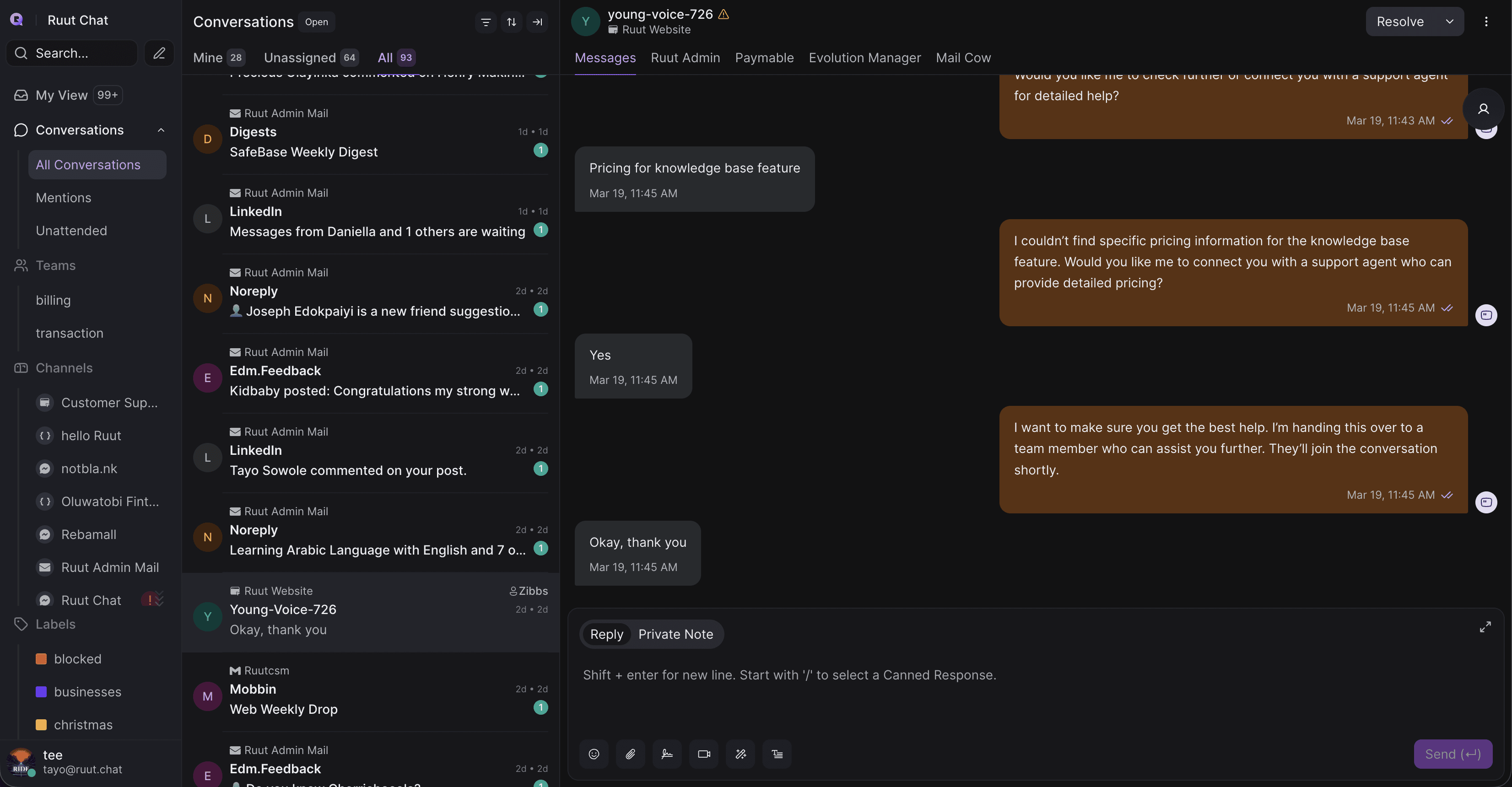
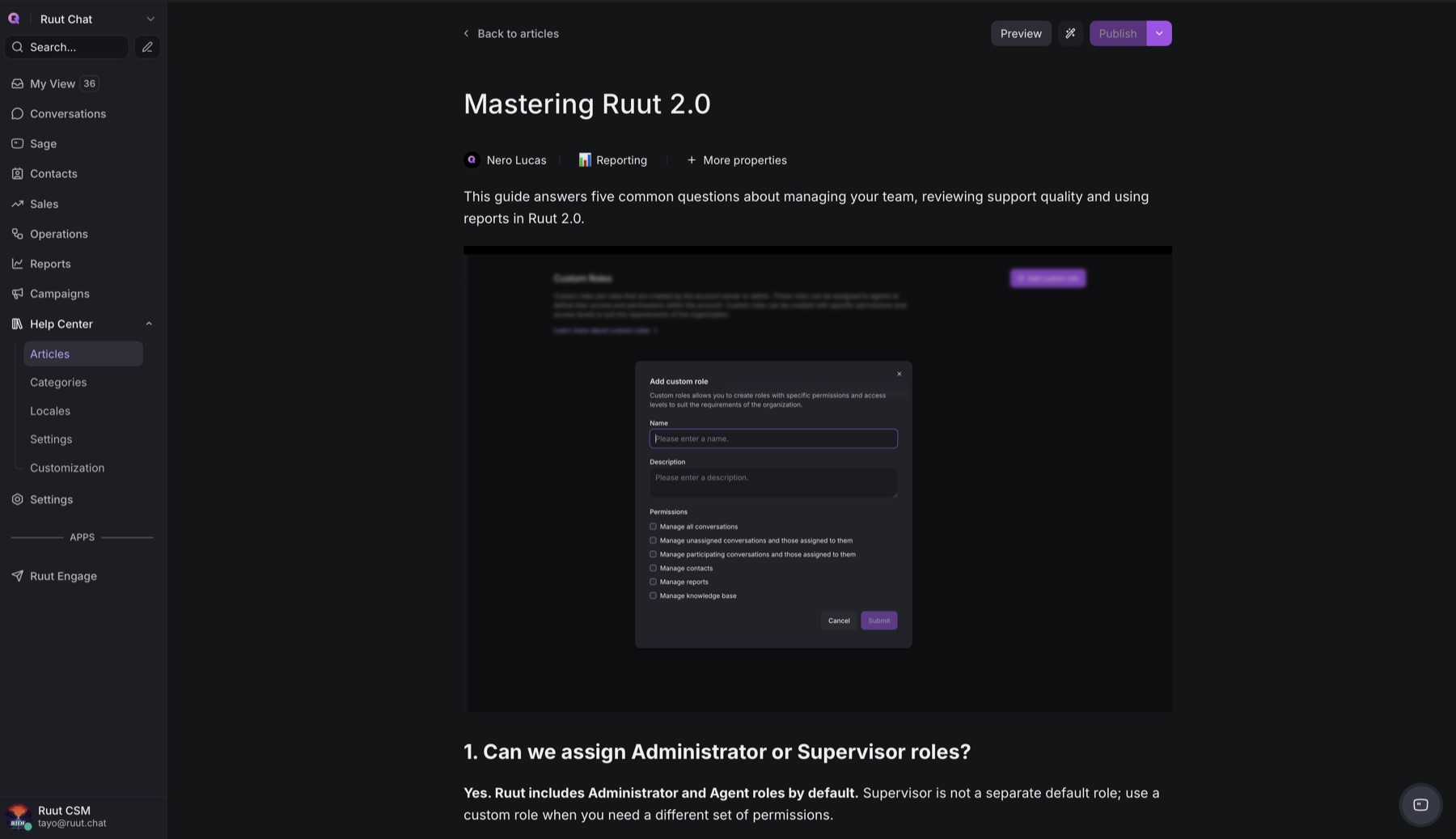
Cover artwork: AI-generated editorial imagery for Ruut. People and settings are illustrative; product screenshots in this guide show the actual Ruut interface.
Frequently asked questions
Will AI replace my customer support team?
No. AI takes repetitive questions off your team's plate so people can focus on complaints, exceptions and relationships, the conversations where they make the biggest difference.
How do I stop an AI agent from making things up?
You cannot guarantee zero errors. Use current sources, restricted tools, evaluation questions and clear escalation rules; review failures and correct the underlying cause.
What should never be fully automated?
Complaints from upset customers, billing disputes, policy exceptions and legal, medical, financial or safety topics. AI can help with these, but a person should decide.
Can AI handle WhatsApp and phone calls?
Sage supports messaging and voice use cases described on the product page. Confirm the channels, languages, tools and voice handoff available in your setup, then test them with representative enquiries.
How long does it take to set up?
It depends on knowledge quality, integrations, permissions and the scope of testing. A short setup is not the same as a production-ready rollout.
Editorial review: 23 November 2026. The rollout plan is a suggested operating approach, not a guaranteed result or setup time. Product reference: Sage AI. Product screenshots are supplied by Ruut.


No comments yet.