
A customer discovers your business on Instagram, asks about delivery on WhatsApp, and calls when an order is late. The customer sees one relationship. Your team needs a way to see it that way too.
Ruut and Intercom both bring AI and human support into customer communication. The useful comparison is how each fits your channels, budget and daily work—not which product has the longest feature list.
This guide compares their published offerings and gives you a practical way to evaluate them. It is written by Ruut, so we explain our strengths while acknowledging where Intercom may be a better fit.
The short answer
Shortlist Ruut if social messaging, local Nigerian pricing and connected business calls are central to your operation. Shortlist Intercom if you want its established helpdesk workflows and Fin ecosystem, or if Slack and Discord are important support channels. In either case, test the actual workflows your customers need before committing.
Ruut vs Intercom at a glance
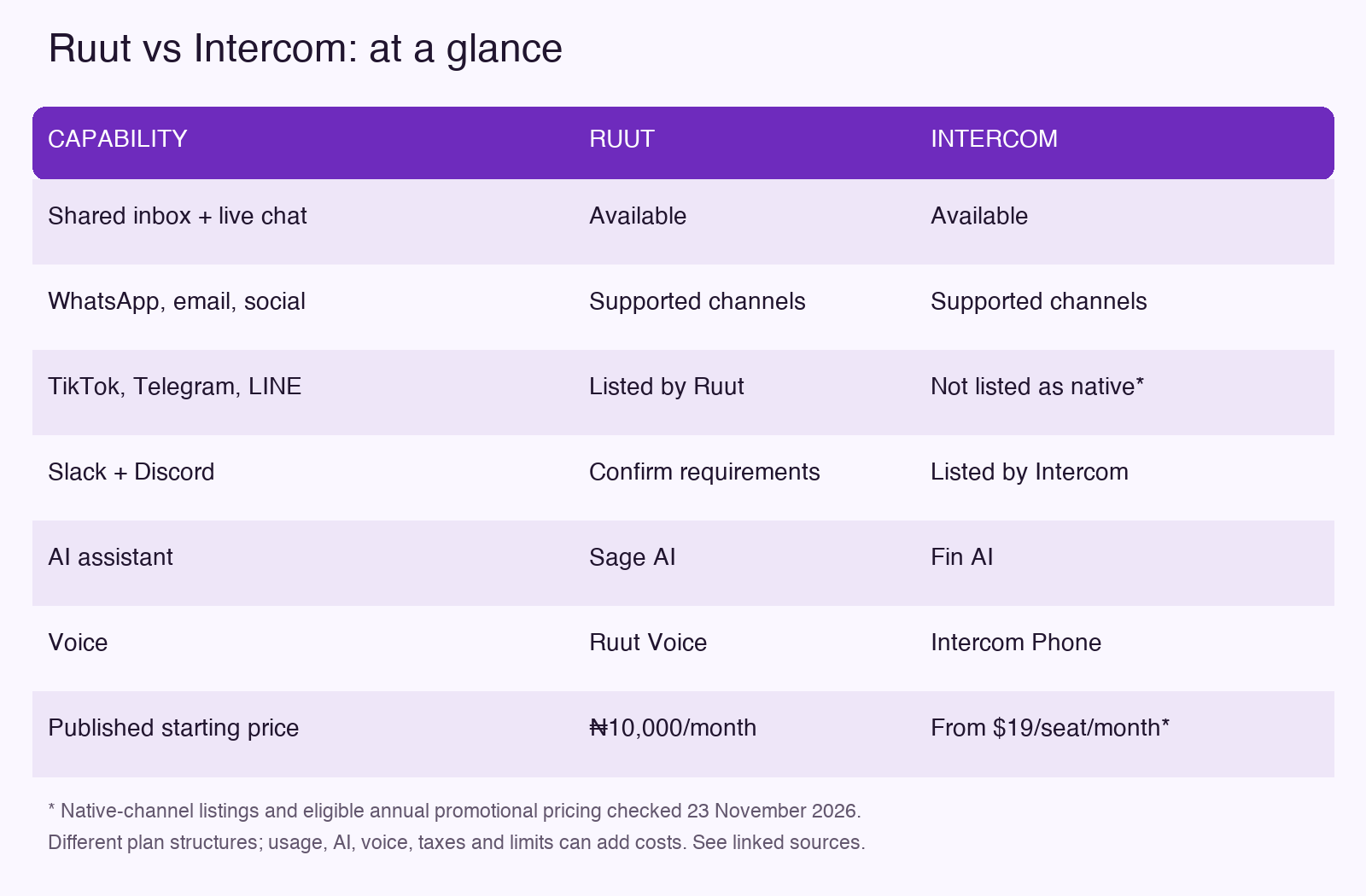
- Both platforms offer a shared inbox, website chat, WhatsApp, email, AI and voice capabilities; plan requirements vary.
- Ruut lists TikTok, Telegram and LINE. Intercom’s native channel overview does not list these; third-party integrations may differ.
- Intercom lists Slack and Discord. Confirm the required workflow with Ruut rather than assuming equivalent native support.
- Ruut publishes monthly plan prices in naira; Intercom publishes seat prices plus usage charges. Compare a complete quote for your team.
1. Start with the channels your customers use
With Ruut Chat, your team can manage website chat, WhatsApp, email and social conversations in a shared inbox. Its published channel list also includes TikTok, Telegram and LINE—useful when customer enquiries arrive from several messaging communities.
Intercom’s omnichannel overview lists Messenger, email, phone, SMS, WhatsApp, Instagram, Facebook, Slack and Discord. Those last two deserve attention if you support a B2B or community-led product.
Channel count alone is a weak buying criterion. Bring a real example to the demo: can an agent recognise a returning customer, see the relevant history, assign the conversation and hand it to a teammate? Ask how identity matching works across different phone numbers and email addresses. Do not assume that connecting two channels automatically merges every customer record.
2. Sage AI and Fin: test actions as well as answers
Sage AI is Ruut’s AI teammate. It can use business knowledge, follow configured scenarios, interact with connected tools and hand conversations to people. Ruut also describes voice assistance through its calling offering.
For example, an order-status assistant needs a working connection to your order system. Without that connection, no AI should pretend it has checked a delivery. For refunds or account changes, decide which actions require human approval and make that boundary part of your evaluation.
Intercom’s Fin AI offering combines knowledge-based answers, external-system actions and human handoff. It is a strong candidate for teams already building their support operation around Intercom.
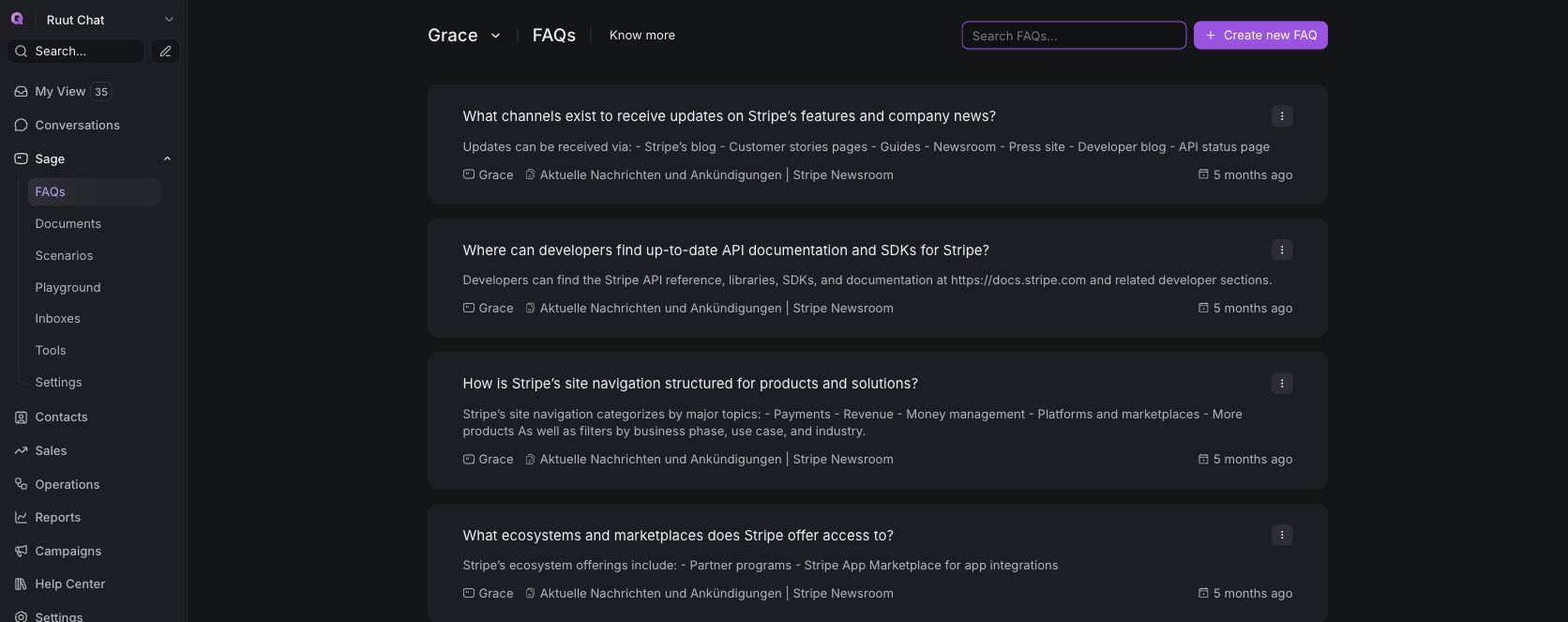
Test both products with the same small set of enquiries: a straightforward policy question, a missing order, an ambiguous request, an unsupported language and a customer asking for a person. Check accuracy, permissions and handoff quality. A convincing demonstration is a starting point; successful handling of your own cases is better evidence.
3. Compare the full bill, not just the headline
Ruut’s published pricing starts at ₦10,000 per month for Chat and ₦15,000 for Chat + Calls, with Enterprise priced by agreement. Annual billing advertises a 15% saving. Fair-use conditions and data-retention limits apply.
Intercom’s pricing page currently advertises annual Essential pricing from $19 per seat per month for eligible new customers, discounted from $29. Advanced is $85 and Expert $132 per seat per month on annual billing. Fin is listed from $0.99 per outcome; channel usage and add-ons can add costs. Promotional eligibility and terms matter.
For illustration, five Advanced seats at $85 total $425 per month on annual billing, before other charges. That arithmetic is not a direct comparison with a Ruut plan: confirm the agent allowance, feature access and expected usage in each quote. We have not converted dollar prices into naira because exchange rates change.
- Confirm seats, team limits and the features your chosen plan includes.
- Estimate AI usage, voice minutes, phone numbers and messaging charges separately.
- Check taxes, billing commitment, retention and any migration costs.
- Ask what happens when usage grows or a promotional discount ends.
Ruut’s naira-denominated plans give Nigerian businesses a locally priced starting point. That can simplify planning, but local pricing still needs to be evaluated against the capabilities and capacity your team will use.
4. Include phone calls in your evaluation
Ruut Voice makes business calling part of Ruut’s broader communication offering. Check number availability, routing, recording preferences, call rates and how your team receives an AI handoff.
Intercom offers Phone and Fin Voice, which uses support knowledge and can hand calls to people. Its documentation currently says Fin Voice is limited to select customers working with Sales; availability and pricing should be confirmed.
Run a realistic call rather than relying on a feature label. Try a noisy connection, an unfamiliar name and a request requiring a person. Ask whether the agent receives the useful context and whether the recording and transcript meet your operating requirements.
5. Separate support from outbound engagement
Ruut combines support conversations with campaigns in supported Chat plans. Ruut Convert provides a separate offering for campaigns and transactional communication over WhatsApp, SMS and email, including WhatsApp-to-SMS fallback. Its own pricing and service terms apply; do not assume a Chat subscription includes all Convert usage.
Intercom also offers outbound tools and an optional Proactive Support Plus add-on. If onboarding journeys, product tours or proactive messaging are important, compare the exact experience you need and its cost—not a generic “campaigns” checkbox.
6. Choose around your operating context
For a Nigerian business, the buying decision may involve naira budgets, a WhatsApp-heavy enquiry queue and a small team covering several roles. Ruut is worth considering when those priorities match your operation. A business elsewhere in Africa should check local number support, payment options and channel availability rather than assume the same setup applies in every country.
Intercom may be the better fit when your team needs its particular integrations, support workflows or in-app engagement tools. Ruut may be the better fit when its channel mix, calling offering and commercial model solve your immediate problems with less operational overhead. The right answer can change as your company grows.
A practical shortlist checklist
- Map your five most common customer requests and your busiest channels.
- Use the same sample enquiries to test both products, including a human handoff.
- Request a written quote covering your team size, AI usage and calling volume.
- Check migration, security, data handling and retention requirements.
- Choose the platform your agents can use confidently—and review the decision as your needs change.
Ready to see whether Ruut fits your team?
Explore Ruut’s plans to compare Chat, Chat + Calls and Enterprise. Bring your channels, team size and a few real customer scenarios so we can discuss the setup you need.
Sources and editorial notes
Ruut Chat channels and features
Intercom native-channel overview
Fin Voice deployment and availability
Last reviewed: 23 November 2026. Published by Ruut. This article compares public product information; it is not an independent benchmark or a guarantee of feature availability. Prices, promotions and plan limits can change. Intercom is a trademark of its respective owner. Comparison artwork was created for Ruut; the Sage workspace image is supplied by Ruut.
No comments yet.